The Hook: A Breath of Cold Air on the Dragon's Back
I stepped off the local micro-bus in Xizhazi Village, and the first thing that hit me wasn't the sight of the wall, but the smell. It was the sharp, clean scent of crushed pine needles, damp earth, and the faint, bitter tang of coal smoke curling from a brick chimney nearby. There were no tour buses. No megaphone-toting guides. Just the rhythmic crunch-crunch of my hiking boots on loose shale and the insistent whistle of a mountain wind cutting through the valley.
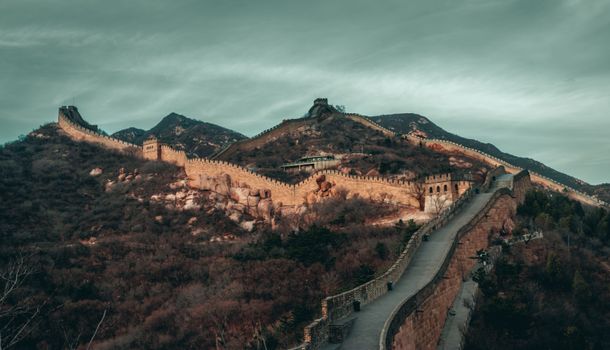
Looking up, the ridge-line was jagged, crowned by a crumbling spine of white dolomite brick that seemed to defy gravity. This was Jiankou. It wasn't the manicured, hand-railed playground shown in tourism brochures. It was raw, dangerous, and absolutely silent.
For decades, international travelers have been funneled into the restored Disney-fied sections of the Great Wall. But the real magic of this ancient defensive network lies in its decay. Over 80% of the Great Wall is "wild"—unrestored, overgrown with wild apricot trees, and slowly reclaiming its place in the northern Chinese wilderness. If you want to experience the Wall not as a tourist attraction, but as a monument to time, empire, and nature, these are the sections tourists never visit worth considering.
---
1. Jiankou: The Untamed Dolomite Dragon
```
▲ [Eagle Flies Facing Upward Watchtower]
/
/ (90-degree near-vertical scramble)
/
▲ [The Sky Stairs]
/
/ (Loose dolomite bricks & wild brush)
/
▲ [Xizhazi Village Trailhead] (Start)
```
If the Great Wall has a wild heart, it is Jiankou. Built on a jagged ridge of white dolomite limestone, this section is famous among local photographers and hardcore hikers for its dramatic, sweeping curves and terrifyingly steep ascents. Unlike the granite blocks of Mutianyu, Jiankou’s white stone stands out like a bleached skeleton against the deep green of the mountains.
The Infamous "Sky Stairs" and "Eagle Flies Facing Upward"
The names of the watchtowers here are not poetic exaggerations; they are warnings. The "Sky Stairs" is a section of stairs so steep and narrow that you must climb them on hands and knees, your chest practically scraping the stone in front of you.
Just beyond lies "Eagle Flies Facing Upward," a watchtower built on a sheer, pointed peak where even the local eagles have to fly vertically to clear the summit. The masonry here is held together by a 500-year-old mortar recipe utilizing slaked lime and sticky rice flour—a Ming Dynasty innovation that has resisted earthquakes and weathering far better than modern cement.
- The Vibe: High-adrenaline, rugged, and visually dramatic.
- The Architecture: Unrestored Ming Dynasty dolomite brick, dramatic drop-offs, and crumbling crenellations.
- Pro-Tip: Do not attempt this hike in wet or icy conditions. The dolomite becomes incredibly slick. Enter from the north side (Xizhazi Village) rather than the south side (Badaohe); the northern approach is shorter and avoids the most dangerous, vertically decayed climbs.
---
2. Huanghuacheng: Where the Wall Meets the Water
```
[Lake Reservoir] ~~~~~~ [Submerged Wall] ~~~~~~ [Lake Reservoir]
| |
[Lakeside Ramparts] --------------------------- [Stone Arch Bridge]
|
[Wild Mountain Trail] -> [Overgrown Watchtower]
```
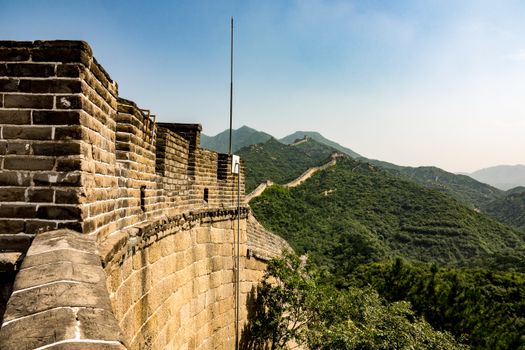
Most people don't associate the Great Wall with deep, emerald-green water, but Huanghuacheng offers exactly that. Built during the Ming Dynasty under the supervision of General Cai Kai, this section was constructed with massive, meticulously carved granite blocks.
When the nearby Xishuiyu Reservoir was flooded in the 1970s, parts of the wall were submerged. Today, three distinct sections of the wall plunge directly into the dark, still waters of the lake, reappearing on the opposite banks like a stone serpent taking a drink.
The Submerged Ramparts of the Lakeside Wall
Walking along the dry sections of Huanghuacheng, you can look down and see the drowned battlements shimmering beneath the water’s surface. It is a hauntingly beautiful sight.
The local legend goes that General Cai Kai spent so much time and money ensuring the absolute perfection of these granite blocks that he was falsely accused of corruption and executed by a suspicious emperor. Years later, an imperial survey proved the construction was so flawless that not a single stone had shifted. The emperor, filled with remorse, had the general's grave marked with a monument and inscribed with the words "Metal Wall and Stone Barrier."
- The Vibe: Serene, poetic, and starkly unique.
- The Architecture: Massive, heavy granite blocks, curved retaining walls, and flooded stone archways.
- Pro-Tip: To bypass the official, paid "Lakeside Great Wall" park area, head to the small village of Zhuangdaokou. From there, a steep, 30-minute dirt path leads directly up to an unmanaged, wild section of the Huanghuacheng wall where you won't see a single ticket booth.
---
3. Gubeikou: The Raw, Unpainted Frontier
```
[Chao River Valley] <=== (Natural Mountain Pass) ===> [Inner Mongolia]
|
[Wohushan (Crouching Tiger Mountain)]
|
[Panlongshan (Coiled Dragon Mountain)] <--- (Battle-scarred brickwork)
```
Gubeikou is not just a wall; it is a battlefield. Located in a strategic mountain pass that historically connected the agricultural plains of central China to the nomadic grasslands of Inner Mongolia, this pass saw over 130 major battles. It is entirely unrestored, dusty, and carries the heavy weight of history.
Walking the Dragon's Back at Wohushan
Gubeikou is split into two main ridges by the Chao River: Wohushan (Crouching Tiger Mountain) and Panlongshan (Coiled Dragon Mountain). The brickwork here is dry, yellow, and crumbling.
Unlike the grand stone walls near Beijing, Gubeikou was built using locally sourced clay bricks fired in small kilns hidden in the nearby valleys. Many of these bricks are stamped with the names of the military units that made them, or the names of the officers responsible for their quality. As you walk, you will find shrapnel scars from the 1933 Battle of the Great Wall, where Chinese forces fought a desperate, bloody defense against the invading Imperial Japanese Army.
- The Vibe: Melancholic, historic, and deeply quiet.
- The Architecture: Earth-filled brick walls, low parapets, and battle-scarred watchtowers with collapsed roofs.
- Pro-Tip: Gubeikou is one of the few places where you can easily hike a continuous, long-distance stretch. You can trek from Gubeikou all the way to Jinshanling (approx. 5-6 hours), though you will need to detour around a restricted military zone mid-way. Look for the hand-painted blue arrows on the mountain bypass path.
---
4. Chenjiapu: The Forgotten Brick Kilns and Wild Ridges
```
[Yanqing Valley] ---> [Hidden Clay Kilns] ---> [Chenjiapu Ridge]
|
[Overgrown Watchtower] <--- [Crumbling Loop] <-------+
```
Located in the hills of Yanqing District, just a few valleys away from the teeming crowds of Badaling, lies Chenjiapu. While Badaling is choked with souvenir stands and concrete reconstructions, Chenjiapu remains completely forgotten. This section is characterized by its wild, looping ridges and the dense oak forests that have grown right up through the center of the ramparts.
The Kilns That Built the Empire
What makes Chenjiapu truly special is what lies in the valleys just below the wall. If you know where to look, you can find the remains of the ancient brick kilns used by Ming Dynasty laborers.
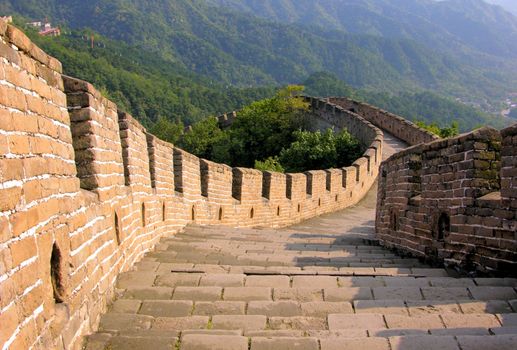
The wall here is constructed of a unique red-tinted brick, giving the ruins a warm, glowing hue during the late afternoon sun. It is a peaceful, meditative hike where the only sound is the rustle of dry oak leaves and the occasional call of a pheasant.
- The Vibe: Secretive, pastoral, and deeply authentic.
- The Architecture: Reddish clay bricks, narrow walkways, and watchtowers half-swallowed by old-growth forest.
- Pro-Tip: Access Chenjiapu via the tiny hamlet of Chenjiapu Village. Ask the locals for the trail leading to the "Lao Chang" (Old Kilns). The path is unmarked, but the villagers are incredibly friendly and will point you in the right direction for a few friendly smiles.
---
5. Xiangshuihu: The Healing Wall of the Mumei Valley
```
[Natural Mountain Spring] === (Water Soughing Lake) ===> [Waterfall]
|
[Medicinal Herb Valley] <--------------------------------------+
|
[The Broken Pass (Moshikou)] ---> [Overgrown Mountain Ridges]
```
Xiangshuihu translates to "Water Soughing Lake." This section of the Great Wall is unique because it was built directly over a natural mountain spring that gushes out of the limestone cliffs, creating a series of waterfalls and deep pools in the valley below.
The Gushing Spring and the Broken Pass
The wall at Xiangshuihu climbs almost vertically up the sheer rock faces of the Mumei (Unnamed) Valley. In the valley floor, the air is cool and damp, thick with the scent of wild mint, Sichuan peppercorn trees, and traditional Chinese medicinal herbs that have grown wild here for centuries.
The wall itself features the "Moshikou" (Double Stone Pass), a heavily fortified gateway that once controlled all traffic through this narrow, watery canyon. The juxtaposition of dry, defensive stone structures and rushing, life-giving water is unlike anywhere else on the Great Wall.
- The Vibe: Refreshing, lush, and mystical.
- The Architecture: High stone foundations, water-diversion channels built into the wall base, and narrow, cliff-hugging walkways.
- Pro-Tip: Visit the "Caves of the Immortals" located just off the main trail. These natural limestone caves were used by Ming Dynasty guards as shelters and storehouses, and they still contain ancient stone beds and hearths.
---
The Budget & Logistics: How to Make It Happen
Navigating the wild sections of the Great Wall requires a bit of planning, a decent map app (like Maps.me or Astrill VPN with Google Maps), and a willingness to step outside your comfort zone.
| Section | Est. Cost (USD) | Difficulty | Best Time to Visit | How to Get There |
| :--- | :--- | :--- | :--- | :--- |
| Jiankou | $40 - $60 (Driver) | Hard / Strenuous | Oct - Nov (Autumn Foliage) | Bus 916 Express from Dongzhimen to Huairou, then local taxi/Heiche to Xizhazi Village. |
| Huanghuacheng | $35 - $50 (Driver) | Moderate | May - June (Wildflowers) | Bus 916 Express to Huairou, then transfer to the H21 local bus to Zhuangdaokou. |
| Gubeikou | $15 (Train/Bus) | Moderate | Sept - Oct (Cool, clear skies) | Take the suburban train line S5 from Beijing Bei Station directly to Gubeikou Station. |
| Chenjiapu | $50 - $70 (Driver) | Moderate / Hard | April (Apricot blossoms) | Best accessed via private driver from Beijing (approx. 2 hours each way). |
| Xiangshuihu | $10 (Bus/Entry) | Moderate | July - August (Rushing springs) | Bus 916 Express to Huairou, then local bus H34 directly to the scenic area entrance. |
The "Heiche" (Black Cab) Survival Guide
To reach the wildest sections, you will likely need to hire a local driver, commonly referred to as a Heiche (literally "black car," meaning an unregistered taxi). This is a standard and generally safe way to travel in rural China, but you must negotiate the price before you get into the car.
- Write down your destination in Chinese characters (e.g., 箭扣长城 for Jiankou).
- Agree on a round-trip price that includes the driver waiting for you at the trailhead for 4–5 hours.
- Show them the agreed amount on your phone calculator to avoid any language-barrier misunderstandings.
---
Insider Travel Rules for Wild Wall Exploration
- Pack Out What You Pack In: There are no trash cans on the wild wall. If you bring a plastic bottle of Tsingtao beer or a wrapper of instant noodles, carry it back down to the village. The preservation of these ruins depends entirely on the respect of those who visit them.
- Ditch the Cotton: The climbs are steep and sweaty, but the mountain ridges are windy and cold. Wear moisture-wicking layers and bring a windbreaker.
- Download Offline Maps: Cell service can be spotty in the deep valleys of Yanqing and Huairou. Download offline topographic maps of the area before you leave Beijing.
- Respect the "No Climbing" Signs: Some sections of the wild wall have signs warning tourists not to climb due to structural decay. While these are often ignored by locals, always exercise extreme caution, stay off highly unstable structures, and never step on loose bricks on the edge of sheer drops.
---