Unleash Your Inner Kid: Traditional Games Locals Will Teach You in October 2025!
The afternoon sun was dipping below the horizon in a small village outside Hoi An, Vietnam, casting long shadows over the dusty path. I was trying to find a quiet spot to read when a cacophony of shouts, laughter, and rhythmic thwacks caught my attention. Peeking around a corner, I saw it: a group of kids, teenagers, and even a couple of elderly men, all engrossed in a game. They were kicking what looked like a colorful badminton shuttlecock back and forth with incredible dexterity, using only their feet, knees, and shoulders. My presence, a curious foreigner with a wide grin, didn't go unnoticed for long. Within minutes, a young boy, no older than ten, beckoned me over with an enthusiastic "Cô ơi! Chơi đi!" (Auntie! Play!).
Hesitantly, I joined. My first few attempts at Da Cau (Vietnamese shuttlecock kicking) were, to put it mildly, pathetic. The shuttlecock would fly off in unpredictable directions, usually straight into the dirt. But nobody laughed at me; they laughed with me. They patiently showed me how to balance, how to kick, how to keep it airborne. By the time the stars began to pepper the darkening sky, I still wasn't a master, but I had sweated, laughed, and most importantly, connected. That evening, sharing a simple meal with my new friends, I realized something profound: some of the richest travel experiences don't come from ticking off famous landmarks, but from the spontaneous, joyful act of play with locals.
And you know what? October 2025 is the perfect time to seek out these authentic, heartwarming moments. With cooler weather settling in many regions, harvest festivals bringing communities together, and the peak summer crowds having dispersed, it’s prime time for locals to gather and share their traditions. So, pack your sense of adventure (and maybe some comfortable shoes!), because Tripsora is taking you on a global playground tour.
The Magic of Play: Why Traditional Games Matter More Than Ever
In an increasingly digital world, the simple, tactile joy of a traditional game is a powerful antidote. These aren't just pastimes; they are living threads connecting generations, preserving history, and reflecting the values of a culture. When you learn a traditional game from a local, you're not just moving pieces or chasing a ball; you're:
- Breaking Down Barriers: Language might be a hurdle, but laughter and shared effort transcend words. Play is a universal language.
- Gaining Authentic Insight: You see how a community interacts, what they value (strategy, teamwork, individual skill), and their sense of humor.
- Creating Unforgettable Memories: Forget the staged photos. The memory of a shared game, a high-five with a stranger, or the triumphant cheer of a new friend will stick with you long after the souvenirs fade.
- Supporting Local Culture: By engaging, you show appreciation for their heritage, encouraging its continuation.
Ready to swap your smartphone for a shuttlecock, a board, or even a heavy metal disc? Let's dive into some incredible traditional games you can learn from locals in October 2025!
Asia's Playgrounds: From Kite Fights to Skipping Ropes
Asia is a continent brimming with ancient traditions, and its games are no exception. Often played outdoors in bustling parks or quiet village squares, these games offer a vibrant snapshot of local life.
1. Philippines: Patintero – The Art of the Block
Imagine a giant game of tag, but with a strategic grid and defenders who can only move along designated lines. That's Patintero, a beloved Filipino game often played by kids and adults alike, especially during community gatherings or after school.
How it's played:
Two teams face off on a rectangular grid drawn on the ground. One team (the "guards") positions players on the lines, blocking the opposing team (the "runners") from crossing to the other side and back without being tagged. It's a thrilling dance of agility, strategy, and quick reflexes. Think of it as a dynamic, human chess game!
My Anecdote:
During a particularly lively barangay (village) fiesta in Cebu in late October, the air was thick with the scent of roasted pork and the sound of laughter. I saw a group of teenagers playing Patintero and was immediately captivated by their swift movements. A friendly local, seeing my interest, explained the rules and, to my surprise, invited me to join his team. My height was an advantage as a "guard," but my lack of agility meant I was often outmaneuvered. The local kids, with their incredible speed and nimble footwork, zipped past me with ease. My teammates, however, cheered my every effort, and I learned quickly that the true fun wasn't just in winning, but in the shared exertion and the collective roar of encouragement. It was a fantastic way to feel part of the community, even if just for an afternoon.
Where to find it in October 2025:
Look for community events, local parks (especially late afternoon), schoolyards, or fiestas in smaller towns and villages. Don't be shy to ask locals if they know where a game is being played!
2. Vietnam: Da Cau – The Graceful Shuttlecock Kick
As mentioned in my introduction, Da Cau is a national obsession in Vietnam, and for good reason. It's beautiful to watch, challenging to master, and incredibly fun.
How it's played:
Players use their feet, knees, chest, and head to keep a feather shuttlecock (often weighted with rubber or plastic) airborne. It can be played solo, in a circle, or even competitively over a net. The goal is simple: don't let it touch the ground!
Where to find it in October 2025:
You'll see groups playing Da Cau in nearly every park across Vietnam, especially in the early mornings and late afternoons. Hoan Kiem Lake in Hanoi, or any public park in Ho Chi Minh City or Da Nang, are excellent places to observe and, if you're lucky, be invited to join. October's milder weather is perfect for outdoor play.
3. India: Gilli Danda – The Rural Bat-and-Ball Challenge
Predating cricket, Gilli Danda is an ancient Indian game that's still popular in rural areas and among children. It requires skill, precision, and a good eye.
How it's played:
Two sticks are used: a larger one (the danda, like a bat) and a smaller, spindle-shaped one (the gilli). The player uses the danda to flick the gilli into the air, then strikes it as far as possible. Points are scored based on the distance the gilli travels.
My Anecdote:
During a village stay near Jaipur, Rajasthan, I noticed a group of boys playing Gilli Danda in a dusty field. The rhythmic crack of wood against wood was intoxicating. One of the older boys, noticing my fascination, offered me the danda. It was surprisingly tricky! The gilli is small and hard to hit, and my first few swings were wild misses. But with their patient guidance, I eventually managed a decent flick, sending the gilli soaring. The boys cheered, and though my attempt was probably mediocre by their standards, their encouragement made me feel like a champion. It was a simple, yet profoundly connecting moment that transcended language.
Where to find it in October 2025:
This game is more common in rural and semi-urban areas of India. Ask locals in smaller towns or villages if they know where children or adults play Gilli Danda. Many festivals in October might also see impromptu games.
Latin America's Lively Lobbies: Strategy & Skill
Latin America pulsates with life, and its traditional games are often infused with the same vibrant energy, combining skill, strategy, and often, a good dose of friendly competition.
1. Colombia: Tejo – The Explosive National Sport
If you're looking for a game that literally goes with a "boom," then Tejo is your calling. Colombia's national sport is a unique blend of bocce, horseshoes, and explosives. Yes, explosives!
How it's played:
Players throw heavy metal discs (tejos) at a clay pit, aiming for a target ring (bocín) filled with small, triangular packets of gunpowder (mechas). A direct hit on a mecha results in a satisfying explosion and a shower of sparks – a mecha! Points are awarded for hitting the bocín, getting closest, or, most thrillingly, causing a mecha.
My Anecdote:
My first Tejo experience in a cancha de tejo (tejo court) in Bogotá was unforgettable. The air was thick with the smell of gunpowder, beer, and friendly rivalry. My Colombian friend, Juan, patiently explained the rules, but nothing prepared me for the sheer thrill of a mecha. My first few throws were embarrassingly off-target, but then, with a mighty heave, my tejo landed squarely on a mecha. The BOOM! was incredibly loud, and the crowd erupted in cheers. It was an adrenaline rush unlike any other game I've played, a truly unique cultural experience that combines sport, social gathering, and a bit of controlled chaos. Many canchas serve beer and snacks, making it a fantastic evening out.
Where to find it in October 2025:
Tejo courts are common in cities and towns across Colombia. Ask your hotel or local friends for the nearest cancha de tejo. Many are open-air and perfect for October evenings. Expect to pay a small fee per game or per hour, often including a drink.
2. Mexico: Lotería – The Illustrated Bingo
Lotería is more than just a game; it's a cultural institution in Mexico, a vibrant and often hilarious form of bingo played with illustrated cards and a caller who recites riddles or phrases associated with each image.
How it's played:
Players have individual boards (tablas) with 16 images. A caller draws a card from a deck, announcing its name (e.g., "El Gallo" – The Rooster). Players mark the corresponding image on their tabla with beans or pebbles. The first to complete a row, column, or specific pattern shouts "¡Lotería!" to win.
My Anecdote:
I spent a rainy October afternoon in Oaxaca with a local family, and they pulled out a well-worn Lotería set. The grandmother, with a twinkle in her eye, became the caller. Her witty, often cheeky, descriptions of each card had everyone roaring with laughter. "La Sirena, la que se ahoga por un beso" (The Mermaid, the one who drowns for a kiss) she'd quip, and everyone would chuckle. Even though my Spanish was rudimentary, the visual nature of the game and the infectious joy of the family made it easy to follow along. It was a heartwarming experience, a glimpse into the intimate, playful side of Mexican family life.
Where to find it in October 2025:
Lotería is primarily a family and community game. If you're staying in a homestay, befriending locals, or attending a local gathering (especially around Day of the Dead in late October), you're likely to encounter it. Many markets also sell beautiful Lotería sets if you want to bring one home.
Europe's Enduring Pastimes: Simple Joys, Deep Roots
Europe's traditional games often reflect centuries of social gathering, pub culture, and community events, offering charming ways to connect with local heritage.
1. Ireland: Skittles & Pub Games – A Pint and a Play
Beyond the lively music, Irish pubs are often hubs of traditional games, where locals gather for a pint and a friendly competition. Skittles (similar to bowling) and various dart games are perennial favorites.
How it's played:
Skittles involves rolling a ball or throwing wooden cheeses (discs) to knock down pins (skittles). Rules vary by region and even by pub, adding to the local charm. Dart games are self-explanatory but often played with unique local scoring systems or variations.
My Anecdote:
On a brisk October evening in a small pub in County Clare, the kind with a roaring fireplace and walls adorned with ancient photographs, I found myself drawn to a corner where a group of older gentlemen were intensely focused on a game of Skittles. They were using heavy wooden discs, not balls, and the clatter of wood against wood filled the cozy space. One of the men, seeing me observing, gestured for me to join. With a pint of Guinness in hand, I learned the surprisingly nuanced technique of throwing the "cheese" to maximize pinfall. The banter was quick, witty, and utterly Irish, and though I was terrible, I felt completely at home, sharing laughs and stories over a game that had probably been played in that very spot for generations.
Where to find it in October 2025:
Rural pubs across Ireland are your best bet. Ask the barkeeper if there's a local skittles league or if they have boards for darts or other pub games. October's cooler weather makes a cozy pub even more inviting.
2. Italy: Bocce – The Gentle Art of Proximity
Bocce (or Bocce Ball) is a beloved Italian pastime, often played in parks, town squares, or dedicated courts. It's a game of precision, strategy, and gentle competition, often accompanied by lively conversation and a glass of wine.
How it's played:
Two teams (or individuals) compete by throwing large bocce balls as close as possible to a smaller target ball called the pallino (or jack). Players can also use their balls to knock opponents' balls away or to protect their own.
My Anecdote:
Strolling through a sun-drenched piazza in a small Tuscan town one crisp October afternoon, I noticed a group of elderly men, impeccably dressed, engaged in a game of bocce. Their movements were slow and deliberate, but their eyes were sharp, and their strategizing was intense. One of them, noticing my lingering gaze, invited me to watch, explaining the subtle nuances of each roll. Later, he even offered me a turn. The weight of the ball in my hand, the satisfying thud as it landed, and the collective "Ah!" or "Bravo!" from the onlookers made it a moment of pure, unadulterated Italian charm. It wasn't just a game; it was a social ritual.
Where to find it in October 2025:
Look for bocce courts in public parks (parchi), piazzas, or dedicated sports clubs (circoli sportivi) across Italy. Many smaller towns will have informal games happening.
Africa's Rhythmic Rituals: Storytelling Through Games
Africa's games are often deeply interwoven with storytelling, community, and strategic thinking, reflecting the rich history and diverse cultures of the continent.
1. Ghana: Oware – The Ancient Seed Game of Strategy
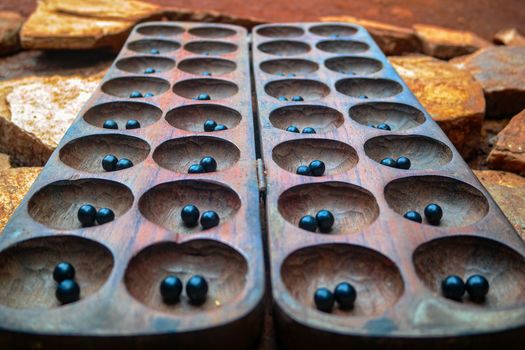
Oware is one of the oldest games in the world, a variant of the Mancala family of games, played across Africa and the Caribbean. It's a game of mathematical precision, foresight, and strategic planning.
How it's played:
Played on a wooden board with two rows of six holes (or sometimes scooped-out depressions in the earth), players distribute seeds or pebbles from one hole to another, aiming to capture their opponent's seeds. The rules are simple to learn, but the strategy can be incredibly deep.
My Anecdote:
In a bustling market in Accra, Ghana, the vibrant colors and sounds were overwhelming. Amidst the haggling and laughter, I noticed a quiet corner where an elderly man was teaching a young boy to play Oware on a beautifully carved wooden board. The intensity in their faces was captivating. Mustering my courage, I asked if I could learn. The old man, with a kind smile, nodded. He patiently guided my hand, explaining the concept of "sowing" and "capturing" seeds. My mind, accustomed to fast-paced digital games, struggled to grasp the long-term strategy, but the meditative rhythm of picking up and distributing the seeds was incredibly calming. It was a lesson not just in a game, but in patience and focused thought, a true cultural exchange.
Where to find it in October 2025:
You'll often find Oware being played in markets, community centers, and even on street corners in Ghana and other West African nations. Ask local vendors or your accommodation hosts to point you in the right direction. Many local craft markets will also sell beautiful wooden Oware boards.
How to Find Your Game & Play Like a Local (Practical Tips for October 2025)
Ready to dive in? Here’s how you can make sure your October 2025 trip includes these incredible, interactive experiences:
- Be Observant & Approachable: Keep an eye out for groups playing in parks, plazas, community centers, or even quiet street corners. A friendly smile and genuine curiosity go a long way.
- Ask Locals: Your hotel staff, guesthouse hosts, tour guides, and even market vendors are invaluable resources. Ask them, "Are there any traditional games played around here? Where can I see them, or even join?"
- Timing is Key (October 2025):
- Festivals: October is a month of harvest festivals (like Diwali in India, or various autumn celebrations across Europe and Asia), community gatherings, and often cooler, more pleasant weather for outdoor activities. Check local calendars for events.
- Afternoons/Evenings: Many games are played after school or work, or as social activities in the late afternoon and early evening.
- Weekends: Weekends are naturally prime time for community play.
- Learn Basic Phrases: A simple "Hello," "Thank you," and "May I join?" in the local language can open doors. (e.g., "Hola, ¿puedo unirme?" in Spanish, "Xin chào, tôi có thể tham gia không?" in Vietnamese).
- Be Respectful & Enthusiastic: Show genuine interest. Be patient when learning, and don't be afraid to make mistakes – that's part of the fun! Laugh at yourself, and they'll laugh with you.
- Offer to Share: If you know a simple game from your own culture (like rock-paper-scissors or a simple card game), offer to teach it in return. This creates a wonderful two-way cultural exchange.
- Safety First: While most impromptu games are perfectly safe, always be aware of your surroundings, especially if you're in an unfamiliar area. Trust your instincts.
- Capture the Moment (Respectfully): These moments are incredibly Instagram-worthy! Ask permission before taking photos or videos, especially if children are involved. Share your experiences with #TripsoraGames and tag us!
- Embrace the Unpredictable: The beauty of these experiences is their spontaneity. You might not find a game every day, but when you do, it will be a truly authentic and rewarding encounter.
Your Adventure Awaits: Play Your Way Through October 2025!
Stepping outside your comfort zone to engage in a local game is one of the most rewarding ways to travel. It strips away the pretense, bypasses language barriers, and connects you directly to the heart and soul of a community. The joy, the laughter, the shared effort – these are the moments that transform a trip into an unforgettable journey.
So, as you plan your October 2025 adventures, don't just visit; participate. Don't just observe; play. Seek out these vibrant traditional games, learn from the locals, and let the universal language of fun create memories you'll cherish forever. Which game will you try first? Share your plans in the comments below, and let's inspire each other to play our way around the world!
---