The Unburdened Traveler: How to Never Pay Baggage Fees Again (Before Everyone Else Catches On!)
The year was 2017. I was beaming, having just snagged an incredible flight deal from London to Marrakech on a budget airline. £29! A steal! I pictured myself wandering vibrant souks, sipping mint tea, and soaking in the Moroccan sun. Fast forward to check-in, where my slightly-too-large carry-on was eyed suspiciously by a stern-faced agent. "That'll be £50, sir, for an oversized cabin bag." My heart sank faster than a lead balloon in the Atlantic. £50! More than the flight itself! I paid it, grumbling, feeling utterly defeated. That moment, standing sheepishly at the counter, was my turning point. I vowed then and there: never again.
Since that humbling experience, I’ve transformed into a baggage fee ninja, a sworn enemy of airline surcharges. I’ve refined my packing strategy, invested in smart gear, and learned the subtle art of navigating airline policies. And guess what? I haven’t paid a single baggage fee since. Not for a weekend getaway to Rome, not for a two-week adventure through Vietnam, not even for a month-long digital nomad stint in Medellín.
You might be thinking, "That's impossible! Airlines are clamping down!" And you're right, they are. As travel rebounds and margins tighten, airlines are getting craftier with their fees. But that just means we need to get even craftier. This isn't just about saving money; it's about reclaiming your travel freedom, moving through airports with an almost arrogant ease, and feeling utterly unburdened. Welcome, fellow adventurer, to the secret society of fee-free flyers. Let’s unlock these secrets before the mainstream catches on!
1. The Mindset Shift: From Packer to Pro-Packer (Embrace the Light)
The first, and arguably most crucial, step in becoming a baggage fee ninja is a fundamental shift in your mindset. Forget everything you think you "need" to bring. Most of us are over-packers, victims of the "just in case" syndrome. That extra pair of shoes? The five different outfit options for a three-day trip? The entire medicine cabinet? Ditch 'em.
The "What if?" vs. "What will I actually use?" Challenge:
Before you even think about luggage, sit down and genuinely assess your travel needs. Are you going to a remote jungle or a bustling city? Do you really need those hiking boots for a beach holiday? My personal rule of thumb is the "Rule of Three": If I can't think of at least three distinct uses for an item, it doesn't come. This applies to clothing (can this shirt be dressed up or down? Worn multiple times?), toiletries (travel-size and multi-purpose only!), and even electronics.
My "Aha!" Moment:
I once packed a full-sized hairdryer for a trip to Lisbon, convinced the hostel wouldn't have one. Of course, it did. It sat in my bag, unused, adding weight and taking up precious space. The sheer frustration of lugging it around for nothing taught me a valuable lesson: trust that your destination will have what you truly need, or that you can buy it there if absolutely necessary. The psychological freedom of traveling light is addictive. You're nimbler, less stressed, and more present. It’s a game-changer.
2. The Gear Game-Changer: Investing in Smart Luggage (Your Secret Weapon)
Your luggage isn't just a container; it's your primary tool in the fight against fees. Choosing the right bag is paramount. Forget the bulky hard-shell suitcases unless you enjoy paying extra. We're talking about maximizing every single centimeter allowed for your carry-on and, crucially, your "personal item."
Mastering the Dimensions:
Every airline has different size restrictions for carry-ons and personal items. Low-cost carriers like Ryanair, Spirit, and EasyJet are notorious for strict enforcement. Full-service airlines (Delta, American, British Airways) are often more forgiving. Before every trip, check the specific airline's policy. Write it down. Memorize it.
- Carry-on: Generally, 22 x 14 x 9 inches (56 x 36 x 23 cm) for major airlines. Budget airlines are often smaller, e.g., Ryanair's free small personal item is 40x25x20cm, with a paid carry-on option.
- Personal Item: This is where the magic happens! Usually, it must fit under the seat in front of you. Common dimensions are 18 x 14 x 8 inches (45 x 35 x 20 cm), but this varies wildly.
My Go-To Gear:
* Convertible Backpacks: My absolute favorite. A good travel backpack (like the Osprey Farpoint 40L or the Nomatic Travel Bag) is designed to maximize carry-on dimensions while remaining comfortable. They open like a suitcase, making packing easy, and have hidden straps for a sleek look. Crucially, they lack rigid frames that add bulk.
* The Power of the Personal Item: This is your secret weapon. Instead of a small handbag, choose a structured tote bag or a small backpack that just fits the maximum personal item dimensions. My favorite is a simple, no-frills backpack that, when not overstuffed, looks unassuming but can expand to hold a surprising amount. Think strategically about its shape – a rectangular bag often fits better than a rounded one.
* Compression Cubes: These are not just for organization; they are for space creation. They literally compress your clothes, allowing you to fit more into a smaller space. I use a mix of large and small cubes for different clothing types. They've saved me countless times from the dreaded "overstuffed bag" look.
* Wearable Luggage (Strategic Use): For extreme cases, consider a multi-pocket travel vest or jacket. Brands like Scottevest specialize in this, with dozens of hidden pockets. I've personally worn a large jacket with essentials like chargers, a book, and even a small toiletries bag in its pockets, making my carry-on lighter and less suspect. Just make sure it doesn't look ridiculously bulky!
3. The Art of Strategic Packing: Every Item Counts (The Tetris Masterclass)
Now that you have the right mindset and the right gear, it's time to pack like a pro. This isn't just about fitting things in; it's about optimizing every cubic inch.
The Rolling vs. Folding Debate (and the Bundle Wrap Winner):
* Rolling: Good for minimizing wrinkles and creating compact cylinders. Works well for t-shirts, jeans, and casual wear.
* Folding: Traditional, but can create bulk and creases.
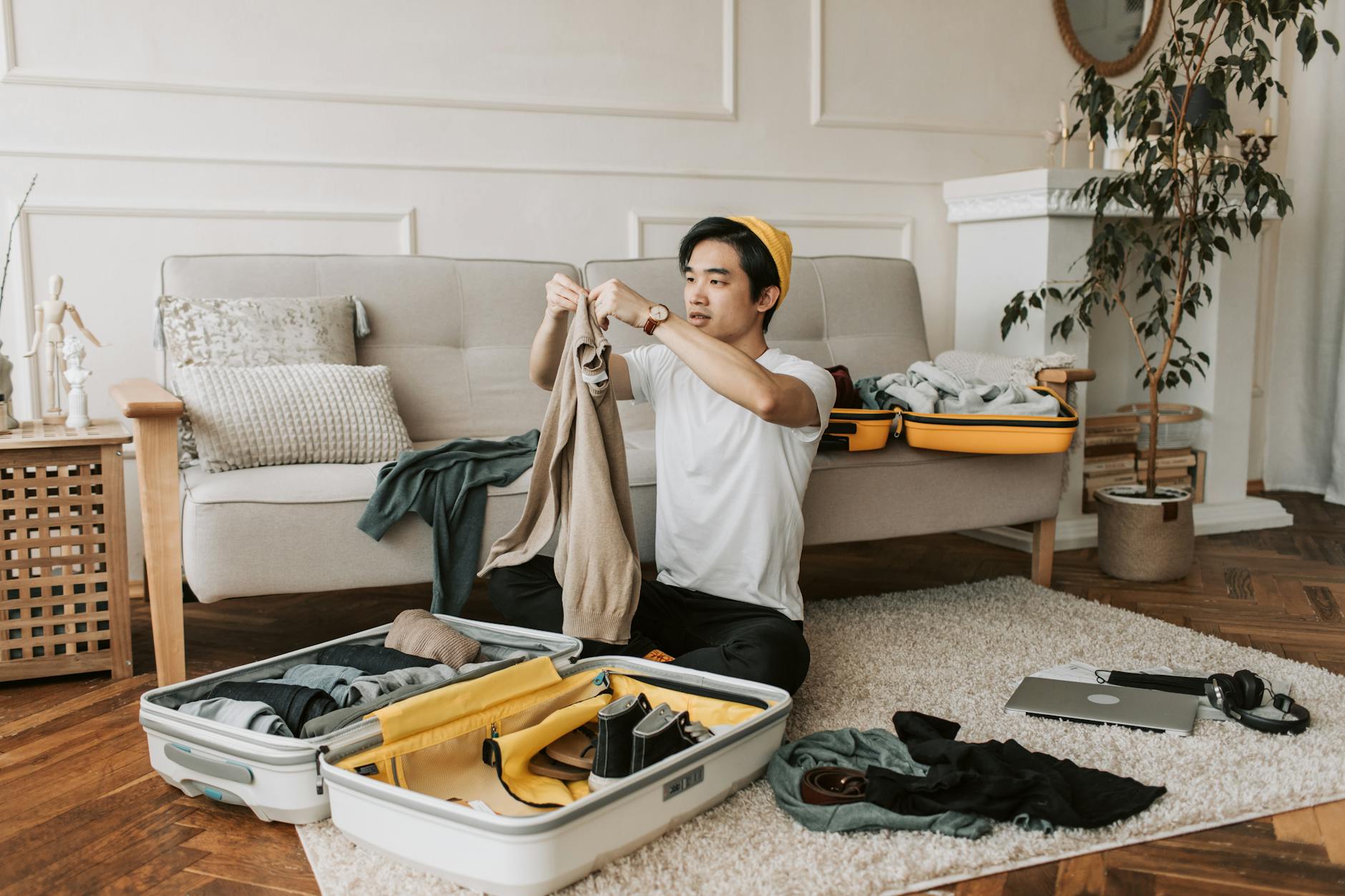
* Bundle Wrapping: My personal favorite for maximizing space and minimizing wrinkles. You essentially wrap smaller items (underwear, socks) inside larger items (shirts, pants) around a central core (like a toiletry bag). This creates a single, dense bundle that fills space efficiently and prevents shifting. A quick YouTube search for "bundle wrapping" will show you the magic.
Multi-Purpose Magic:
* Sarong/Scarf: A sarong can be a towel, a beach blanket, a skirt, a dress, a head covering for religious sites, or even an emergency blanket. A large scarf can add warmth, style, and double as a pillow on the plane.
* Shampoo Bars & Solid Toiletries: Ditch the liquids (and the 3-1-1 rule!). Solid shampoo, conditioner, body wash, and even toothpaste tabs save space, weight, and eliminate leak worries. Brands like Lush or Ethique are fantastic.
* Quick-Dry Fabrics: Invest in a few quick-dry shirts, underwear, and socks. You can wash them in your hotel sink and have them dry overnight, drastically reducing the amount of clothing you need to pack.
* Digitalize Everything: Tickets, boarding passes, guidebooks, maps, entertainment – all on your phone or tablet. Leave physical copies at home.
The "Wear Your Bulkiest Items" Rule:
This is non-negotiable. Wear your heaviest shoes (hiking boots, sneakers), your bulkiest jacket, and your thickest jeans or sweater on the plane. Don't pack them. You can always take layers off once you're on board. I've often seen people struggling with an overstuffed carry-on, only to realize they could have worn their heavy coat. It's a simple, yet highly effective, trick.
Anecdote:
For a month-long trip through Southeast Asia, I managed with just my Osprey Farpoint 40L and a small backpack. My secret? A few quick-dry outfits, strategically packed compression cubes, solid toiletries, and the knowledge that I could buy anything I truly needed (or wanted) in places like Bangkok or Hoi An for a fraction of the cost. I felt so light and free, able to hop on and off buses, boats, and trains without a second thought. It was transformative.
4. Airline-Specific Ninja Moves: Knowing the Rules (and Bending Them)
While the general principles apply, truly mastering the fee-free game requires an understanding of airline nuances.
Research, Research, Research:
Before you even book, check the baggage policies of potential airlines. Sometimes, a slightly more expensive ticket on a full-service airline (that includes a free carry-on and personal item) ends up being cheaper than a budget airline ticket plus their exorbitant baggage fees.
- Low-Cost Carriers (LCCs): Be extremely vigilant with airlines like Ryanair, Spirit, Frontier, and EasyJet. Their business model relies heavily on ancillary fees. Their free personal item allowance is often tiny. If you need more, sometimes paying for the "priority boarding" add-on (which often includes a larger carry-on) is cheaper than paying for a checked bag at the airport.
- Full-Service Airlines: Generally more generous. You'll usually get a free carry-on and personal item. The trick here is to ensure your carry-on actually fits their dimensions and isn't overweight.
Leverage Status and Credit Cards:
* Airline Elite Status: If you fly frequently with one airline alliance, reaching even low-tier elite status often comes with perks like free checked bags. This can be a lifesaver for longer trips or when you absolutely must bring more.
* Travel Credit Cards: Many co-branded airline credit cards offer a free checked bag for the cardholder and sometimes even companions on the same booking. This is an incredible value proposition if you regularly fly with that airline. For example, some American Airlines or Delta SkyMiles cards offer this. Do your homework!
Online Check-in is Your Friend:
Always check in online. This minimizes your interaction with gate agents at the counter, where they might scrutinize your bag more closely. Head straight to security with your pre-approved boarding pass.
The "Gate Check" Gamble (and How to Win):
Sometimes, on full flights, airlines will offer free gate checking for carry-ons due to limited overhead bin space. This is a voluntary option you can often exploit. If your bag is slightly oversized but not ridiculously so, you might be able to get it checked for free at the gate. However, don't rely on this. It's a bonus, not a strategy. And never check anything valuable or essential!
Anecdote:
I was once flying with Spirit Airlines, notoriously strict. I knew my personal item backpack (a slightly larger-than-average one) was borderline. I checked in online, proceeded directly to the gate, and waited until the very last minute to board. The gate agent was busy rushing people through, and my bag, strategically placed on my back, went unnoticed. Had I approached the counter earlier, it might have been flagged. It was a small victory, but a victory nonetheless.
5. The "Personal Item" Power Play: Maximizing Your Free Space (The Under-Seat Alchemist)
This is where the true innovation happens. The personal item is your golden ticket to fee-free travel. It's the one bag that always flies free. Learn to love it, nurture it, and maximize its potential.
Understanding the Limits (and Pushing Them):
While airlines specify dimensions, they rarely weigh personal items. This is key. A soft-sided personal item that can be squished under the seat is your best friend. A slightly larger bag that looks small and is malleable enough to fit into the sizer (if challenged) is the goal.
The "Pillow Hack" (Use with Caution & Style):
This is a classic, slightly cheeky hack. Some travelers stuff clothes into a pillowcase and carry it on as a "travel pillow." Airlines generally don't count pillows as personal items. While effective, it can look a bit disheveled. If you're going for this, make sure it's a stylish pillowcase and not just random laundry stuffed in! I've used this for an extra jacket or a bulky sweater on a cold weather trip.
The "Duty-Free Bag" Trick:
After security, pop into a duty-free shop. Buy a small, inexpensive item (a candy bar, a bottle of water). The store will give you a duty-free bag. You can then discreetly transfer some smaller, heavier items (like toiletries, chargers, books) from your carry-on or personal item into this "new purchase" bag. Airlines rarely question duty-free bags. This is particularly useful for items that add weight but not much bulk.
The "Camera Bag" Loophole:
If you're a photographer, many airlines allow a dedicated camera bag (in addition to your carry-on and personal item) as long as it's not excessively large. Check the specific airline's policy, but this can be a great way to bring extra gear or even just more essentials disguised as camera equipment.
Anecdote:
On a flight to Reykjavik with a strict personal item policy, I knew my small backpack was slightly over. I bought a small bag of Icelandic candy at duty-free, and as I walked to the gate, I transferred my tablet and a heavy book into the duty-free bag. It looked like I'd just done some last-minute shopping. The gate agent barely glanced at me, and I sailed through. It felt like winning the lottery!
6. The Long-Term Game: Sustaining Your Fee-Free Lifestyle (The Zen of Less)
This isn't just about one-off hacks; it's about adopting a sustainable travel philosophy.
Laundry on the Road:
This is crucial. Instead of packing a week's worth of clothes for a two-week trip, pack three days' worth and plan to do laundry.
* Hostels/Airbnbs: Many offer laundry facilities, sometimes for a small fee, sometimes free.
* Local Laundromats: Embrace the local experience! They're often cheap and a great way to see a different side of a city.
* Sink Washing: For quick-dry items, a travel laundry soap bar (like a Dr. Bronner's bar) and a hotel sink are all you need. Hang items to dry overnight.
Buy Essentials at Your Destination:
Don't pack bulky toiletries, snacks, or even some clothing items if you know you can easily (and cheaply) buy them upon arrival. This is especially true for longer trips or destinations where these items are readily available and affordable. Need sunscreen for Bali? Buy it in Bali!
The Satisfaction of Nimble Travel:
Beyond the cost savings, flying fee-free is incredibly liberating. You glide through airports, never waiting for checked bags, never stressing about lost luggage. You're mobile, agile, and ready for adventure at a moment's notice. This freedom is infectious and will make you a more confident, relaxed traveler.
Share Your Wisdom:
As part of this secret society, we encourage you to share your own tips and tricks. The more we learn from each other, the better we become at navigating the ever-changing landscape of airline fees.
Join the Unburdened Movement!
Paying baggage fees is a relic of the past, a tax on the unprepared. By adopting these strategies – the minimalist mindset, smart gear choices, strategic packing, airline savvy, and personal item power plays – you too can join the ranks of the unburdened traveler. You'll save money, reduce stress, and experience travel in a whole new, liberating way.
So, what are you waiting for? Ditch the oversized luggage, embrace the freedom of less, and start your fee-free journey today. Your wallet (and your back) will thank you.
What are YOUR best baggage fee hacks? Share your tips and tricks in the comments below using #TripsoraFeeFree and let's build the ultimate guide together!
---