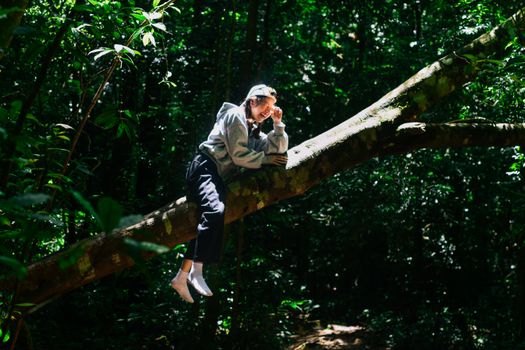
I Stepped Into the Moss, and My Brain Finally Shut Up
I stepped off the local "Toppy" jetfoil at Miyanoura Port, and the air didn't just smell different—it felt heavy, like a wet wool blanket made of cedar and ancient secrets. My heart rate, usually a frantic staccato thanks to a month of London deadlines, began to thud a slow, rhythmic bass line. I wasn’t even on the trail yet, but the Yakushima air was already doing the work.
As I moved deeper into the Shiratani Unsuikyo Ravine, the "Princess Mononoke" vibes weren't just an aesthetic choice by Studio Ghibli; they were a biological reality. I pressed my palm against a 3,000-year-old Sugi tree, and for the first time in years, the "to-do list" loop in my brain simply... evaporated.
This isn't woo-woo magic. This is science. And if you’re ready to trade your morning espresso for a dose of phytoncides, here are the trails that are scientifically proven to fix you.
---
1. Yakushima, Japan: The OG of Shinrin-yoku
Japan invented the term Shinrin-yoku (forest bathing) in 1982, and Yakushima is its undisputed cathedral. The island is home to the Yakusugi—ancient cedars that have survived for millennia.
The Science:
Researchers from Chiba University have spent decades studying these woods. They found that visitors experience a 12.4% decrease in cortisol levels and a 50% increase in Natural Killer (NK) cell activity (the cells that fight off viruses and tumors) after just two days here. The secret? The intense concentration of phytoncides—antimicrobial organic compounds emitted by the trees to protect themselves from rot. When you breathe them in, your immune system goes into overdrive.
The Insider Experience:
Don't just follow the crowds to Jomon Sugi. Instead, head to the Taikoiwa Rock overlook via the Shiratani Unsuikyo trail.
* Pro-Tip: The "hidden" entrance to the most vibrant moss beds is located just past the second suspension bridge. Look for the trail marker that seems to disappear into a creek; follow the stones, and you’ll find a clearing where the silence is absolute.
* The Vibe: Deep emerald greens, dripping moisture, and the scent of damp earth and spicy cedar.
---
2. The Hoh Rain Forest, USA: The Sound of Silence
Located in Washington State’s Olympic National Park, the Hoh Rain Forest is one of the few temperate rainforests in the world. It is also home to "One Square Inch of Silence," the quietest place in the United States.
The Science:
Acoustic ecology is a major component of forest bathing. Constant "technological noise" keeps our sympathetic nervous system (fight or flight) in a state of low-level chronic stress. The Hoh's massive Sitka Spruces and Western Hemlocks act as natural sound baffles. Studies show that "pure" natural soundscapes lower blood pressure and improve cognitive function by allowing the prefrontal cortex to rest.
The Insider Experience:
Walk the Hall of Mosses trail, but do it at 6:30 AM.
* Pro-Tip: Most tourists stop at the iconic mossy "curtains." If you keep walking toward the Hoh River trail for another mile, you’ll hit a gravel bar where the glacial water is a milky turquoise. Sit there. Don't move. Let the elk find you.
* The Vibe: Ghostly, draped clubmoss, prehistoric ferns, and a silence so thick you can hear your own heartbeat.
---
3. The Black Forest (Schwarzwald), Germany: The Terpene Powerhouse
Germany has a long history of "Kur" (cure) culture, where doctors literally prescribe time in the forest. The Black Forest, specifically around the spa town of Baden-Baden, is the epicenter of European forest therapy.
The Science:
The dense canopy of Norway Spruce and Silver Fir creates a unique microclimate. These trees are prolific producers of terpenes, which have been clinically shown to reduce inflammation in the respiratory system. The German "Luftkurort" (air health resort) certification isn't handed out lightly; the air quality here is monitored for purity and oxygen density.
The Insider Experience:
Take the Merkur Mountain Railway up, but hike down through the Stadtwald.
* Pro-Tip: Look for the "Wildgehege" (wildlife park). There is a specific grove of Silver Firs near the red deer enclosure where the terpene concentration is highest in the late afternoon as the sun warms the needles.
* The Vibe: Grimm’s Fairy Tales meets high-end wellness. Think dark, moody woods and crisp, pine-scented air.
---
4. Tarkine Wilderness, Australia: The Ancient Air
In the remote northwest of Tasmania lies the Tarkine, the largest cool-temperate rainforest in the Southern Hemisphere. This is a "Gondwanan" forest, meaning it looks much as it did 65 million years ago.
The Science:
The air here is some of the cleanest on Earth, blown in from the Southern Ocean over thousands of miles of open water. Research into "negative ions" (abundant near the Tarkine’s many waterfalls and fast-moving rivers) suggests they can significantly improve mood and alleviate depression by increasing serotonin levels.
The Insider Experience:
Base yourself in Waratah and head to the Philosopher Falls track.
* Pro-Tip: The local "Leatherwood" trees bloom in summer. Their scent is intoxicating—honey-sweet and slightly musky. If you find a fallen blossom, crush it between your fingers for a natural aromatherapy hit.
* The Vibe: Wild, rugged, and smelling of ancient leather and cold rain.
---
5. Arashiyama Bamboo Grove, Japan: The Visual Reset
While technically a grass, the towering stalks of Arashiyama in Kyoto offer a different kind of forest bathing focused on "Fractal Geometry."
The Science:
Humans are evolutionarily wired to find "fractals" (repeating patterns in nature) soothing. The vertical lines of bamboo and the way light filters through the leaves (a phenomenon the Japanese call Komorebi) induce alpha brain waves—the same waves produced during deep meditation.
The Insider Experience:
Avoid the main "Instagram" strip. It’s a circus.
* Pro-Tip: Enter through the Okochi Sanso Villa gardens. You pay a small fee (which includes matcha and a sweet), but it grants you access to a private bamboo path that most tourists miss.
* The Vibe: A swaying, creaking sea of pale green. The sound of bamboo stalks knocking together is like a natural wooden wind chime.
---
Logistics & Quick Facts: Plan Your Reset
| Location | Best Time to Visit | Estimated Cost ($/day) | How to Get There |
| :--- | :--- | :--- | :--- |
| Yakushima, JP | May - Oct | $150 - $250 | Flight from Kagoshima or Jetfoil ferry. |
| Hoh Forest, USA | July - Sept | $50 - $120 | 4-hour drive from Seattle; car is essential. |
| Black Forest, DE | Sept - Nov | $100 - $200 | Train to Baden-Baden from Frankfurt (90 mins). |
| Tarkine, AUS | Dec - March | $120 - $180 | Fly to Wynyard (Burnie), then 90-min drive. |
| Arashiyama, JP | Late Oct (Autumn) | $30 - $80 | 15-min train from Kyoto Station (JR Line). |
---
How to Actually "Forest Bathe" (Don't Mess This Up)
If you’re power-walking with a Fitbit, you’re doing it wrong. This is about sensory immersion.
- Phone on Airplane Mode: Better yet, leave it in the car. The blue light ruins the Komorebi effect.
- The 2-Hour Rule: Science shows the physiological benefits peak after 120 minutes of exposure.
- Engage the Senses:
- Touch: Feel the texture of the bark. Is it corky, smooth, or rough?
- Smell: Scratch a needle or a leaf. Inhale.
- Listen: Find the furthest sound you can hear, then the closest.
- Stop and Sit: Find a "sit spot." Stay there for 20 minutes. Watch how the forest changes when it forgets you are there.
---
The Verdict
We aren't meant to live in boxes staring at glowing rectangles. Our biology is still calibrated for the rustle of leaves and the scent of damp earth. These trails aren't just vacation spots; they are pharmacies. Whether you’re standing under a 2,000-year-old cedar in Japan or breathing in the misty air of the Pacific Northwest, you’re giving your nervous system the only thing it actually wants: a chance to remember it’s alive.
Go. Get lost. Find yourself.
---