The Moment I Realized Travel Had Changed
I stepped off the Shinkansen at Tokyo’s Shinjuku Station, the air thick with the sweet, caramelized aroma of roasted chestnut taiyaki and the rhythmic, high-pitched chirping of acoustic guidance systems. Surrounding me was a human sea of commuters moving at breakneck speed.
In most of the world's transit hubs, navigating this chaos with a physical or sensory disability is a masterclass in anxiety. But as I watched a station attendant seamlessly deploy a lightweight, folding ramp to help a traveler in a power wheelchair board the train—bowing deeply as the doors closed—I realized something profound. True luxury in travel isn't a five-star hotel pillow menu. It is friction-free dignity.
```
[Train Platform] ──(Station Attendant with Ramp)──> [Accessible Train Car]
│
└───(Tactile Yellow Tenji Blocks)─────────> [Acoustic Guide Exit]
```
For too long, travelers with disabilities have had to pay double: extra fees for accessible vans, high rental costs for mobility scooters, and premium rates for specialized tours. But a quiet revolution is happening. Driven by updated legislation like the European Accessibility Act and post-pandemic tourism revamps, several nations now offer world-class accessibility infrastructure to international visitors completely free of charge.
Here is the definitive, data-backed guide to the countries leading the charge in free accessibility services for tourists.
---
1. Japan: The Gold Standard of Seamless Transit Assistance
Japan’s commitment to barrier-free travel is legally mandated and meticulously executed. Under the amended Barrier-Free Act, transit operators are required to provide free boarding assistance to anyone requiring physical aid.
Free Station Assistance (Ekinnai Kaijo)
You do not need to book private, expensive transport to navigate Japan's complex rail networks. At any JR or subway station, simply approach the ticket gate and point to a wheelchair icon or state "Kaijo onegai shimasu" (Assistance, please).
An attendant will immediately coordinate with your destination station. They will escort you to the platform, lay down a portable bridge plate to cover the train gap, and ensure another staff member is waiting at your exact carriage door when you arrive at your destination. This service costs ¥0 and is available to domestic and international tourists alike.
```
Step 1: Approach JR Ticket Gate ──> Step 2: Request "Kaijo" Assistance ──> Step 3: Escorted Boarding via Ramp ──> Step 4: Attendant Meets You at Destination
```
Tactile Paving and Acoustic Landmarks
Tokyo and Kyoto are sensory triumphs. The yellow tactile paving stones (Tenji blocks) underfoot aren't just random bumps; they are a highly sophisticated navigation language. Straight bars indicate "go," while raised domes mean "stop or hazard." At major intersections, acoustic traffic signals play distinct melodies (like the traditional song Toryanse) or bird chirps to indicate safe crossing directions.
- Pro-Tip: Download the free Japan Transit Planner (Jorudan) app. Toggle the "wheelchair-friendly route" filter to find step-free transfers, elevator locations, and accessible restrooms across all major cities.
---
2. Spain: Free Assisted Beach Bathing and Accessible Urbanism
Spain has quietly transformed into one of the most accessible destinations on the planet, largely due to strict municipal accessibility laws and a cultural dedication to outdoor life.
The "Playas Accesibles" Program
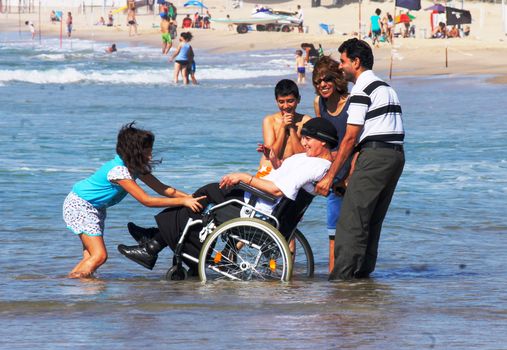
If you have ever tried to push a wheelchair through dry sand, you know it is an exhausting, near-impossible task. Spain solves this with its brilliant, state-funded Playas Accesibles (Accessible Beaches) program.
At designated beaches across Catalonia, Andalusia, and the Canary Islands, local municipalities provide free assisted bathing services. This includes:
* Free use of amphibious wheelchairs (sillas anfibias) that float on water.
* Crutch-like walking aids designed for sand.
* Dedicated hoists for transferring from personal chairs.
* Trained Red Cross lifeguards who will safely guide you into the Mediterranean waves.
```
[Dry Sand Promenade] ──(Wooden Boardwalk)──> [Shaded Accessible Zone] ──(Amphibious Chair + Lifeguard)──> [Sea Bathing]
```
Barcelona’s 100% Accessible Bus Fleet
Every single one of Barcelona’s TMB buses is equipped with a low-floor entry and an electric ramp that deploys at the touch of a button. The metro system is over 90% accessible with spacious glass elevators. Unlike other cities where you must pay a premium for accessible taxis, Spain’s public infrastructure makes exploring the city completely free of physical barriers.
- Pro-Tip: For the ultimate beach experience, head to Nova Icària Beach in Barcelona. The assisted bathing service operates daily from June to September. Look for the blue and white tents marked with the wheelchair icon near the middle of the promenade.
---
3. United Kingdom: Free Companion Entry and the Radar Key System
The UK excels at removing the financial burden of disability through smart, nationwide initiatives that extend directly to international visitors.
The Companion/Carer Ticket Policy (Essential Companion Scheme)
In the UK, it is widely recognized that many disabled travelers cannot travel alone. To offset this, almost every major tourist attraction—including the Tower of London, Kew Gardens, the British Museum, and West End theatres—offers a free Companion Ticket.
If you purchase a standard ticket and present proof of disability (such as an international access card, a doctor's letter, or even a foreign blue parking badge), your companion gets in completely free.
The National Key Scheme (Radar Key)
To prevent accessible public toilets from being vandalized or occupied by non-disabled users, the UK uses a standardized lock system.
For just £5, tourists can purchase a Radar Key online or at local tourist information centers. This single key unlocks over 9,000 clean, spacious, radar-locked accessible toilets in parks, train stations, and shopping centers across England, Scotland, and Wales.
```
[Standard Public Restrooms] (Often crowded/inaccessible)
[Radar-Locked Restroom] ──(Insert £5 Radar Key)──> [Spacious, Clean, Accessible Oasis]
```
- Pro-Tip: Collect a free Sunflower Lanyard at any major UK airport or train station customer service desk. This globally recognized lanyard discreetly signals to staff that you have a hidden disability (such as autism, chronic pain, or hearing loss) and may need extra time or assistance.
---
4. Sweden: The "Accessibility Database" and Free Personal Transit Guides
Sweden treats accessibility not as a special accommodation, but as a fundamental human right. This philosophy is reflected in their digital infrastructure.
Tillgänglighetsdatabasen (The Accessibility Database)
Before you even leave your hotel room, Sweden offers a free, highly detailed public search engine called the Tillgänglighetsdatabasen (TD). This database provides physical measurements, lighting conditions, and acoustic details for thousands of public spaces, shops, restaurants, and outdoor trails across Sweden.
If you want to know if a specific seafood restaurant in Gothenburg has a step higher than 2 cm or if the ambient noise level is suitable for sensory sensitivities, the TD will tell you for free.
```
[Search App: Tillgänglighetsdatabasen] ──> [Filters: Step height, door width, lighting, acoustics] ──> [Real-time Accessibility Profile]
```
Free Transit Assistance in Stockholm
Stockholm’s public transport operator, SL, offers a free personal assistance service. If you are nervous about navigating the city's iconic, cavernous subway stations (which double as art galleries), you can call the SL accessibility line 30 minutes before your journey. A trained guide will meet you at the entrance and escort you through the elevators, gates, and onto the train at no cost.
- Pro-Tip: When visiting the historic island of Gamla Stan, avoid the central cobblestone streets if you use a manual wheelchair. Instead, stick to the paved pathways along the waterfront, which offer smooth, flat surfaces and beautiful views of the Baltic Sea.
---
5. Singapore: The Gold Standard of Inclusive Smart Cities
Singapore is arguably the most physically accessible city-state in Asia. Through its Enabling Masterplan, the government has retrofitted the entire island to be completely barrier-free.
Free Wheelchair Loans at Gardens by the Bay
While many global botanical gardens charge high rental fees for mobility devices, Singapore’s iconic Gardens by the Bay offers free manual wheelchair loans to any visitor on a first-come, first-served basis. You only need to present a photo ID at the visitor services counters at the Golden Garden or Floral Fantasy.
```
[Visitor Services Counter] ──(Present ID)──> [Retrieve Clean Manual Wheelchair] ──(Explore Conservatories)──> [Return at No Cost]
```
Tactile and Audio-Guided Smart Hubs
The MRT (Mass Rapid Transit) system is a marvel of inclusive engineering. Every station features multi-sensory directory maps with raised braille, tactile paths leading directly from street level to the train doors, and extra-wide fare gates. The buses are 100% wheelchair accessible, and bus captains are trained to manually deploy ramps for boarding passengers.
- Pro-Tip: If you need a quiet space to decompress from sensory overload, head to the Sensory Trail on Sentosa Island. It is a free, interactive, 350-meter tactile parkway designed with fragrant herbs, tactile sculptures, and soothing water features.
---
6. France: Post-Paralympic Upgrades and Free Louvre Access
Following the Paris 2024 Paralympic Games, France underwent a massive, multi-million-euro accessibility overhaul, making its historic treasures far more reachable for travelers with disabilities.
Free National Museum Access for Disabled Visitors + Companion
France has some of the most generous cultural accessibility laws in Europe. International tourists with disabilities, along with one accompanying companion, receive 100% free entry to all national museums and monuments. This includes the Louvre, the Musée d'Orsay, the Château de Versailles, and the Arc de Triomphe.
```
[Louvre Main Pyramid Queue: 2-Hour Wait]
[Louvre Porte des Lions Entrance] ──(Show Disability ID)──> [Immediate, Free Priority Access for 2]
```
Accès Plus: Free Rail Assistance
If you are traveling between French cities on the high-speed TGV network, you can book the Accès Plus service for free. This service guarantees that rail staff will assist you with luggage, escort you to your spacious, designated wheelchair-accessible seat (which is priced at the lowest standard fare rate), and help you disembark safely.
- Pro-Tip: At the Louvre, do not queue at the main glass pyramid. Instead, head to the Porte des Lions entrance on the south side of the palace. It features a dedicated, step-free elevator and bypasses the massive crowds entirely.
---
Quick Facts: Logistics & Budget Companion Guide
To help you plan your next barrier-free adventure, here is a quick-reference guide to the costs, transit options, and peak times for these highly accessible destinations.
| Country | Key Free Service | Average Daily Budget (USD) | Best Time to Visit | How to Get Around |
| :--- | :--- | :--- | :--- | :--- |
| Japan | Station ramp assistance, Tenji block navigation | $120 - $180 | October to November (Cool, dry weather) | Shinkansen & Subway (100% assisted) |
| Spain | Assisted beach bathing, low-floor bus ramps | $80 - $130 | May to June (Warm but not scorching) | Barcelona Metro & TMB Bus Network |
| United Kingdom | Free Companion tickets, Radar Key restrooms | $110 - $170 | May to September (Mild weather) | London Underground (Step-free map available) |
| Sweden | TD Accessibility Database, transit guides | $130 - $190 | June to August (Long daylight hours) | SL Ferry & Stockholm Metro |
| Singapore | Free wheelchair loans, sensory parks | $140 - $210 | February to April (Slightly less humid) | MRT Subway & Barrier-free buses |
| France | Free entry to national museums + companion | $100 - $160 | September to October (Crowds thin out) | TGV (Accès Plus) & Paris Metro Line 14 |
---
The Takeaway: Travel belongs to everyone
The true measure of a society's sophistication is not its skyscrapers or its Michelin stars; it is how it welcomes those who navigate the world differently. By utilizing these free national services, you can bypass the "disability tax," save thousands of dollars, and experience the thrill of global exploration with the dignity and ease you deserve.
Pack your bags, claim your free companion passes, and let the world's most inclusive destinations welcome you.
---