The Hook: The Day the Mountain Shrank
I stepped off the gondola at Peak 8 in Breckenridge, Colorado, and was immediately hit by the sharp, metallic scent of high-altitude ozone mixed with diesel exhaust from the lift bullwheel. The temperature was a crisp 18°F. Around me, the rhythmic clack-clack-clack of ski boots on metal grates competed with the whoosh of cold wind through the lodgepole pines.
But I wasn't watching the usual crowd of weekend warriors. My eyes were locked on my friend Marcus.
Three years ago, a motorcycle accident left Marcus with a T10 spinal cord injury. He thought his days of carving corduroy were over. Today, however, he was strapped into a lime-green, military-grade aluminum machine equipped with a custom Ohlins shock absorber and a carbon-fiber seat bucket. He held two forearm crutches tipped with miniature ski spatulas.
With a quick wink and a push of his arms, Marcus leaned into the fall line. He didn't just slide; he carved. A massive arc of fresh powder sprayed into the morning sun, backlit like a halo of diamond dust.
This is the reality of modern winter sports. Thanks to a quiet revolution in mechanical engineering and inclusive design, adaptive equipment making skiing possible for everyone right now is transforming mountains from exclusive playgrounds into fully accessible arenas. Whether you are a paraplegic, an amputee, visually impaired, or living with neurodivergence, the snow is calling. Here is your ultimate guide to the gear, the destinations, and the logistics to get you out there.
---
1. The Sit-Ski Arsenal: Mono-Skis, Bi-Skis, and Dual-Skis
For individuals with lower-limb paralysis, muscular dystrophy, multiple sclerosis, or amputations, sit-skis are the ultimate freedom machines. These are not passive sleds; they are high-performance sports cars designed to carve at high speeds.
The Mono-Ski: For the Independent Speed Demon
The mono-ski is designed for skiers with strong upper body strength and trunk control. It features a single ski mounted beneath a molded fiberglass or carbon-fiber seat (the "bucket") via a complex suspension system.
- How it works: The skier uses their hips, upper body, and hand-held outriggers (forearm crutches with small ski tips on the bottom) to balance and initiate turns.
- The Tech: Elite brands like Tessier and KBG use adjustable hydraulic shock absorbers that mimic the natural flexion and extension of human knees.
- Best For: Paraplegics (T10 and below), single-leg amputees, and those with mild cerebral palsy.
The Bi-Ski: Ultimate Stability and Control
If you have limited upper body strength or balance challenges, the bi-ski is your golden ticket.
- How it works: The bucket sits lower to the snow and is mounted over two specially designed skis. This wider base of support makes tipping over much harder.
- The Tech: Devices like the Dynamique by Spokes 'n Motion allow the skier to steer using subtle head and shoulder movements.
- Tethering: Bi-skis can be ridden independently or "tethered" by a certified instructor who skis behind the rider, holding high-strength webbing lines to control speed and assist with turns.
- Best For: Quadriplegics, individuals with severe cerebral palsy, traumatic brain injuries, or multiple sclerosis.
The Dual-Ski: The European Carving Sensation
Popularized in the French Alps, the dual-ski features two skis that move independently but are linked mechanically. This allows the sit-skier to perform authentic, dynamic carving turns, keeping both skis flat on the snow even on steep, icy terrain.
---
2. Standing Tall: Outriggers, Sliders, and Stand-Up Adaptations
Skiing doesn't always require sitting down. For those who can stand but need assistance with balance, strength, or coordination, the industry has developed brilliant mechanical assists.
Three-Track and Four-Track Skiing
* Three-Track: Designed for single-leg amputees or those with hemiplegia. You ski on one standard ski while using two outriggers for balance, creating three points of contact on the snow.
* Four-Track: Designed for skiers with cerebral palsy, spina bifida, or double amputations who use prosthetics. You ski on two standard skis while using two outriggers, creating four points of contact.
Slider Frames (The Snow Walker)
Imagine a heavy-duty walker mounted on skis. The slider frame is connected to the skier's boots and held by an instructor via tethers. It provides physical support and prevents the skier's legs from splaying outward, allowing individuals with severe balance or cognitive challenges to experience the sensation of standing and gliding down a mountain.
CADS (Computer Assisted Descent System)
This ingenious system uses a series of heavy-duty rubber bands and mechanical braces attached to a harness around your waist and connected directly to your ski boots. CADS acts as external quadriceps, taking up to 70% of the weight off your knees and lower back. It is a game-changer for older skiers with severe arthritis or joint degradation.
---
3. Cognitive and Visual Adaptations: The Unseen Tech
Not all barriers to skiing are physical. For individuals with visual impairments or neurodivergence (such as autism or ADHD), the mountain can be overwhelming. Today's adaptive programs solve this through low-tech communication and high-tech gear.
Guiding the Blind: Bluetooth and Bone Conduction
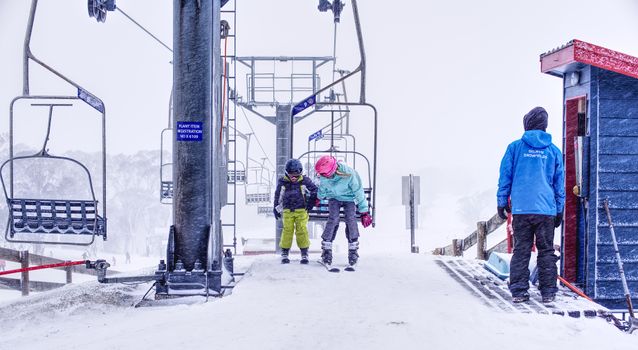
Visually impaired skiers hit the slopes with a trained guide wearing a high-visibility orange bib that reads "Guide." The skier wears a matching bib reading "Blind Skier."
- The Tech: Gone are the days of shouting over the wind. Today, guides and skiers use real-time, hands-free Bluetooth headsets or bone-conduction helmets (like those from Sena).
- The Language: Guides use precise, rhythmic commands: "And turn left... hold... hold... now right... compression ahead... stop." It requires absolute trust and creates a beautiful, shared dance down the mountain.
Sensory-Friendly Instruction
For neurodivergent skiers, adaptive ski schools utilize visual schedules, noise-canceling ear protection, and highly structured, step-by-step progressions. Instructors are trained to read sensory overload cues and use specialized props (like hula hoops and tip clamps) to make learning intuitive and stress-free.
---
4. Where to Ride: The World's Premier Adaptive Ski Hubs
While many resorts offer basic adaptive lessons, a few select destinations have invested millions into world-class infrastructure, barrier-free lodges, and massive fleets of adaptive gear.
Breckenridge, Colorado (Breckenridge Outdoor Education Center - BOEC)
The BOEC is the Harvard of adaptive skiing. Located at the base of Peak 9, their ski cabin is fully accessible, and their staff can adapt almost any piece of equipment to fit your specific anatomy.
* The Vibe: High-energy, incredibly supportive, and deeply integrated into the resort.
* Pro-Tip: Book your lessons at least three months in advance. The BOEC is highly sought after, and slots during peak holidays fill up fast.
Park City, Utah (National Ability Center - NAC)
The NAC boasts a state-of-the-art, 26,000-square-foot accessible lodge right at the base of Park City Mountain Resort. They have an unparalleled inventory of mono-skis, bi-skis, and specialized standing gear.
* The Vibe: Professional, cutting-edge, and highly empowering.
* Pro-Tip: Utilize the NAC's private transport vehicles, which are fully equipped with wheelchair lifts to get you from Salt Lake City International Airport directly to the snow.
La Plagne, France (Oxygène Ski School)
If you want to experience the massive, interconnected slopes of Europe's Paradiski area, La Plagne is the gold standard. Oxygène Ski School has pioneered sit-skiing in Europe, utilizing the latest Tessier dual-skis.
* The Vibe: Alpine charm meets high-tech engineering.
* Pro-Tip: Ask for an instructor certified in "Pilot-Skiing" if you want to sit back, relax, and let an expert guide you through miles of high-altitude glaciers.
---
5. Pro-Tips for a Flawless Adaptive Ski Trip
As a travel journalist who has covered accessible travel worldwide, I’ve learned that the difference between a dream trip and a logistical nightmare lies in the details.
- The 2:00 PM Rental Trick: If you are renting adaptive gear, schedule your fitting for 2:00 PM the afternoon before your first ski day. Fitting a sit-ski or adjusting outriggers to your exact height and weight can take up to two hours. Doing this the day before avoids wasting precious morning snow time.
- The Hidden Accessible Entrance: At Breckenridge Peak 8, skip the main ticket window stairs. Head behind the blue door of the One Ski Hill Place building to find the private elevator that takes you directly to the snow level without navigating icy walkways.
- Check the Snow Profile: If you are using a sit-ski, avoid resorts known for heavy, wet "Sierra Cement" snow. Look for destinations with dry, light powder (like Utah or Colorado). Wet snow makes turning a sit-ski physically exhausting, while light powder allows the machine to glide effortlessly.
- Apply for Grants: Adaptive equipment is expensive. Organizations like the Kelly Brush Foundation and the Challenged Athletes Foundation (CAF) offer generous annual grants to help individuals purchase their own custom sit-skis or outriggers.
---
6. Quick Facts & Budget Breakdown
Planning an adaptive ski trip requires careful financial planning. Here is a realistic look at what to expect.
| Expense Category | Estimated Cost (USD) | Notes / Saving Tips |
| :--- | :--- | :--- |
| Adaptive Lift Ticket | $50 - $120 / day | Many resorts offer deeply discounted tickets for adaptive skiers and their guides/tethers. |
| Adaptive Lesson + Gear | $150 - $250 / half-day | This usually includes a certified instructor, a mono/bi-ski rental, and lift access during the lesson. |
| Private Guide / Tetherer | $200 - $400 / day | Essential if you cannot ski independently but want to explore the whole mountain. |
| Wheelchair-Accessible Lodging| $250 - $600 / night | Look for ADA-compliant ski-in/ski-out properties to avoid pushing through deep snow in a wheelchair. |
| Best Time to Visit | Late January to Early March | The snow base is deep and soft, but the extreme, muscle-tensing cold of December has passed. |
| How to Get There | Fly into SLC (for Park City) or DEN (for Breckenridge) | Both airports feature highly accessible transit options and accessible car rental fleets. |
---
The Verdict: The Mountain is Waiting
As the sun began to dip behind the jagged peaks of the Tenmile Range, painting the sky in shades of bruised purple and liquid gold, Marcus and I finished our final run. His face was flushed red from the cold, his jacket dusted with snow, and his eyes were wider than I’d seen them in years.
"I forgot," he whispered, looking back up at the mountain. "I forgot what it felt like to go fast. To just... gravity-drop without thinking about wheels."
That is the magic of adaptive skiing. It doesn't just adapt the mountain to the skier; it restores the thrill of pure, unadulterated speed. The technology is here. The instructors are trained. The resorts are ready. There are no more excuses.
It's time to pack your bags, head to the high country, and let the snow set you free.
---