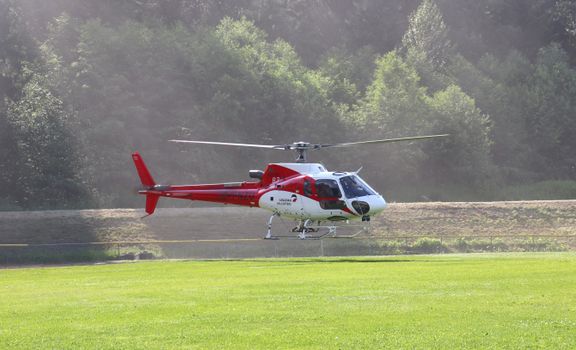
The idea that a helicopter ride could be cheaper than a taxi sounds like a travel hack, but the truth is more nuanced. In nearly every normal situation, a taxi costs far less than a helicopter. There are, however, a few specific circumstances in which a shared helicopter seat becomes competitive, or in which the time saved is worth the price. This article explains how to compare the two honestly, where helicopters make sense, and what to check before booking.
Prices change constantly and vary by operator, season and demand, so this guide avoids exact figures. Always check current fares directly with licensed operators.
The honest baseline
A taxi charges for distance and time, shared among everyone in the car. A helicopter has high fixed costs: fuel, maintenance, pilots, insurance, landing fees and the aircraft itself. Those costs are spread over a small number of seats, usually between a few and a handful.
As a result:
- For a short ride across a city with light traffic, a taxi will almost always be much cheaper.
- For a private charter, the cost per person is high unless you fill every seat.
- For a shared scheduled service, the price per seat can be reasonable relative to the time saved, but is still typically more than a taxi.
So the question is rarely whether a helicopter is cheaper in a straightforward sense. It is whether the time and experience justify the extra cost in your specific case.
Where helicopters genuinely compete
There are circumstances in which the gap narrows, or in which the helicopter's advantage in time becomes significant.
Gridlocked megacities.
In some cities, ground traffic is so heavy that a journey that looks short on the map takes hours. São Paulo is the famous example, with a large number of helicopters used by business travelers and executives. When a taxi might take an hour or more and the helicopter takes minutes, the calculus changes for people who value time highly.
Geographic barriers.
If the route crosses water, mountains or difficult terrain, a taxi may be slow or impossible. Helicopters can cut across, avoiding long detours.
Short scheduled hops between a few established points.
The route between Nice airport and Monaco is a well-known example. A short helicopter shuttle runs between them, taking minutes compared with a road trip that can be slow in busy seasons. It is not cheap, but it is one of the best-known cases where a helicopter transfer is a common choice.
Airport links in major cities.
Over the years, operators in various cities have offered shared helicopter services to airports, sometimes through app-based booking. Availability, routes and pricing change, so look at what exists currently rather than relying on old information.
Shared seats versus private charters
If you are curious about a helicopter transfer, the key distinction is whether you are booking a seat or an entire aircraft.
Shared seat on a scheduled service
- You pay per person.
- Departure times are fixed or semi-fixed.
- Baggage limits may be strict.
- Prices are lower than private charters but higher than ground transport.
Private charter
- You pay for the whole aircraft, regardless of how many passengers you bring.
- Flexible timing and routes.
- Costs rise quickly with distance and waiting time.
- Often the choice for special occasions, business travelers or groups.
If you are traveling as a party of four or five, splitting a private charter can sometimes bring the per-person cost into a range that feels more reasonable, though it will still exceed a taxi.
Add up the full cost of both options
When comparing, include everything.
For a taxi or car service:
- The fare, which may include surcharges at airports or in busy periods.
- Tolls and tips.
- Waiting time if traffic is bad.
For a helicopter:
- The seat or charter price.
- Taxes and landing or handling fees.
- Getting to and from the helipad, which may need a short taxi ride anyway.
- Baggage fees if your luggage exceeds the allowance.
- The possibility of weather cancellation and what happens then.
Ask the operator for a total price in writing, and read the cancellation terms.
Time: what you really save
A helicopter can fly directly, but remember the whole sequence:
- Getting to the helipad or heliport.
- Checking in, which usually requires arriving a little before departure.
- Safety briefing and boarding.
- The flight itself.
- Getting from the landing point to your destination.
For a trip of a few minutes in the air, the surrounding steps can take longer than the flight. The time savings are significant only when the alternative is a long, slow ground trip.
Weather and reliability
Helicopters are more sensitive to weather than cars. Low cloud, poor visibility, strong wind or storms can delay or cancel flights. Many operators fly under visual flight rules, which have specific limits. In winter or in mountainous regions, delays can be common.
Practical points:
- Have a backup plan, such as a taxi or train, especially if the transfer links to a flight or a fixed appointment.
- Ask how the operator handles cancellations and refunds.
- Book earlier flights rather than the last one of the day if you have a deadline.
- Check whether your travel insurance covers weather-related disruptions.
Safety: what to check
Helicopter operations are regulated, and reputable operators follow strict standards. Still, it makes sense to choose carefully.
Checklist:
- Is the operator licensed by the relevant aviation authority?
- Does it have a clear safety record and published procedures?
- Is the aircraft maintained by approved engineers?
- Are pilots experienced for the route and conditions?
- Does the operator carry adequate insurance?
If a deal seems suspiciously cheap, or the operator is vague about licenses, walk away. This is general information, not a guarantee of safety for any specific operator.
Noise and environment
Helicopters are noisy and burn considerably more fuel per passenger than ground transport. Some cities and communities restrict flights or limit them to certain corridors and hours. If environmental impact matters to you, treat helicopter transfers as an occasional treat rather than a default.
When a helicopter is worth it
A helicopter might be worth the money in these situations:
- You have a hard deadline and ground traffic is unpredictable.
- The ground route is extremely long compared with the air route.
- You want a scenic experience as part of the journey, such as flying over a coastline or city skyline.
- You are celebrating something special and want a memorable arrival.
- You are traveling with a group and can share a charter.
When to stay with a taxi or public transport
A taxi, ride share, train or bus is better when:
- The ground journey is short or traffic is light.
- You are on a budget.
- You have a lot of luggage.
- Weather looks uncertain.
- You are traveling alone and would bear the full cost.
For many airport links, a train or express bus is faster and cheaper than both.
Scenic flights are a separate category
Many places offer helicopter sightseeing tours, over cities, glaciers, volcanoes and canyons. These are experiences rather than transport, and they are priced accordingly. If you want a bird's-eye view, compare options such as:
- A short flight with a small group.
- A longer flight with landings at remarkable sites.
- Alternatives such as a viewpoint, cable car, boat tour or observation tower, which cost less.
For a scenic tour, check what is included, whether photography is allowed, how seats are allocated and whether there are weight limits for passengers.
How to book sensibly
- Search directly for licensed operators on the route.
- Compare shared seat prices with private charters if you have a group.
- Read the baggage and cancellation policy.
- Confirm exact departure and arrival points.
- Ask whether prices include taxes and fees.
- Pay through secure methods, and keep your confirmation.
Be careful with unfamiliar booking websites that promise unusually low prices. If something seems too good to be true, it probably is.
A worked comparison
Picture a traveler who needs to get from an airport to a city center during the evening rush. The road distance is not long, but the highway is clogged, and the taxi might take well over an hour. A shared helicopter seat on a short scheduled flight takes only minutes in the air.
Now count the pieces. The helicopter needs a transfer to the heliport, check-in a short while before departure, the flight, and a ground transfer at the other end. The seat costs far more than the taxi fare. If you are traveling alone, you bear all of it. If you are three people sharing a taxi, the ground option looks even cheaper.
On a quiet Sunday morning, the same taxi could take twenty minutes and cost a modest fare. The helicopter would offer no advantage at all.
The lesson is that traffic and group size drive the decision more than the vehicle. A helicopter might make sense on the worst-traffic days for a solo traveler with an urgent meeting, and almost never for a family with luggage on a quiet day.
Alternatives that save time without the cost
If your real goal is to avoid traffic, there are cheaper tools to consider first:
- Rail links to airports, which run on their own tracks and are not affected by road congestion.
- Metro or tram lines, often the most reliable option in dense cities.
- Boats and water taxis, where waterways offer a faster route than the road.
- Scheduling around rush hour, when your flexibility allows it.
- Staying closer to the airport or your meeting, which removes the problem altogether.
Many travelers who start by searching for a helicopter end up on a train, and arrive just as comfortably.
Frequently asked questions
Can a helicopter really be cheaper than a taxi?
Rarely. In unusual situations, such as extreme traffic or geography that forces a very long road detour, a shared seat can feel competitive when you value time. Under normal conditions a taxi is cheaper.
Is a helicopter transfer to an airport a good idea?
It can be if the service is reliable and your schedule is tight. Always have a backup in case of weather delays, and arrive with a time buffer.
How much luggage can I bring?
Limits are often stricter than on airlines, because weight affects performance. Ask the operator before you book.
Are helicopter flights safe?
Regulated commercial operators follow strict standards, but all flying carries some risk and weather matters. Choose licensed operators with good track records.
Summary
Helicopters are almost never cheaper than taxis, but in a few cases such as gridlocked cities, geographic barriers and well-established shuttle routes, the time saved can make the price worthwhile. Compare the full cost of both options, think about how long the transfer really takes, have a backup for bad weather and choose licensed operators. Treat a helicopter ride as a special tool rather than an everyday hack, and confirm prices and services directly with official providers before you book.